


What happened in the Binance hack of 2026?
As of November 3, 2026, Binance says attackers compromised its hot wallets on October 29 and stole about $6.3 billion in token assets. The FBI attributes the theft to North Korea. Binance says it will absorb the loss and has replenished most affected value, but the complete technical root cause is not yet public.
Independent analysis and no affiliation
This article is an independent Ariftly study of publicly available information as of November 3, 2026. Ariftly has no relationship with Binance and is not affiliated with, associated with, sponsored by or endorsed by Binance, any cryptocurrency network, token issuer, blockchain company or law-enforcement agency referenced in this article.
We have no inside access to Binance, its customers, its systems or the investigation. Binance statements are attributed to Binance; the North Korea assessment is attributed to the FBI; calculations and workflow interpretations are labelled as Ariftly analysis. Nothing here is financial, investment or legal advice.
The short version: confirmed facts and open questions
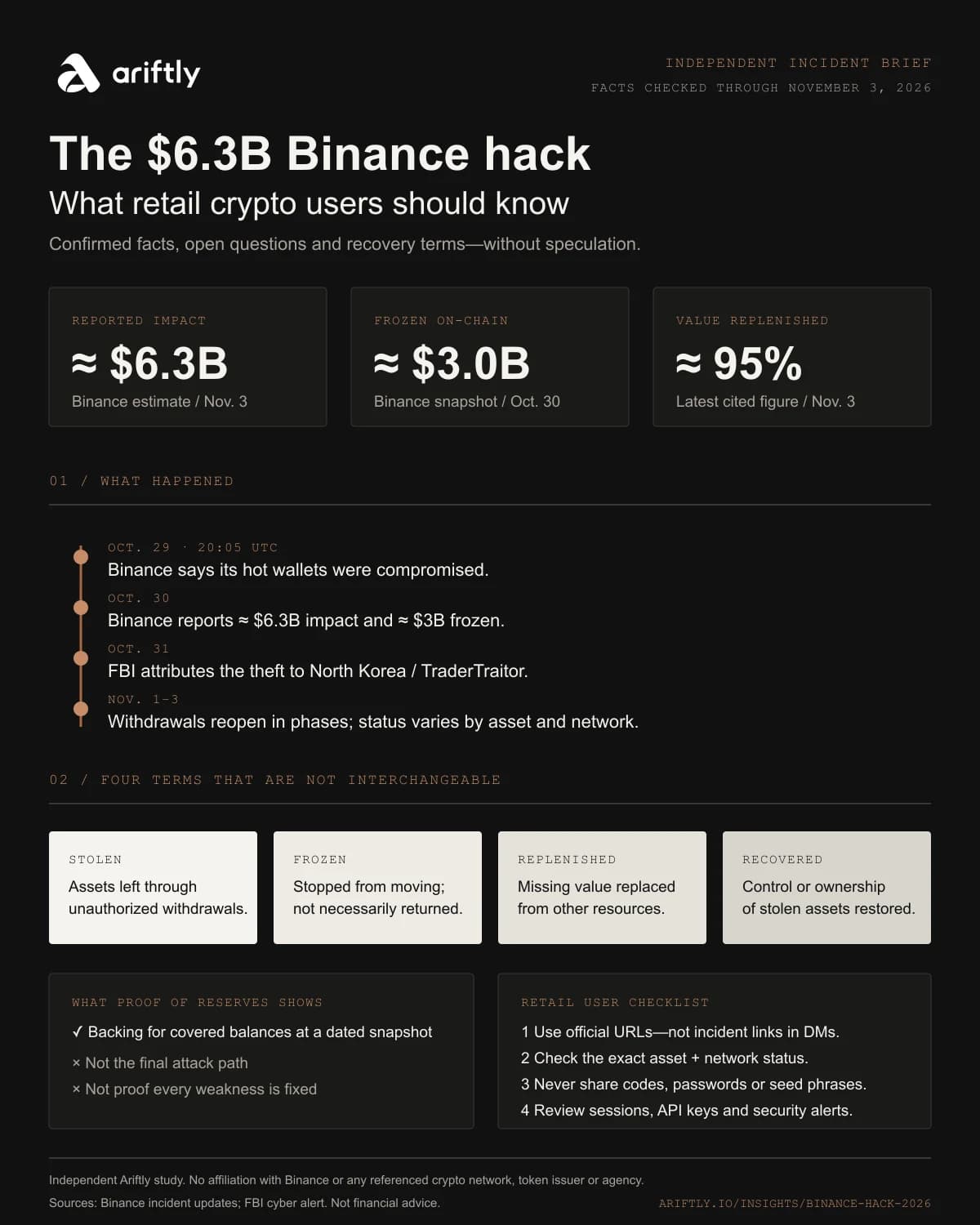
As of November 3, 2026, Binance says its hot wallets were compromised at about 20:05 UTC on October 29, leading to unauthorized withdrawals worth approximately $6.3 billion. Binance also says customer balances will not bear the loss. On October 31, the FBI attributed the theft to North Korea and identified the activity as TraderTraitor.
The most important caution is equally simple: as of November 3, Binance had not published its promised full technical postmortem. Its first update pointed to a compromised DevOps engineer's laptop and access to a service container. A later update said investigators found additional breach points. That preliminary account should not be mistaken for a final attack reconstruction.
| Question | What the public evidence supports |
|---|---|
| How much was stolen? | Binance reports approximately $6.3B in token assets. |
| Did customers take the loss? | Binance says it will absorb the impact using company resources and its protection funds. |
| Were private keys leaked? | Binance says it found no evidence of a private-key leak at that stage. |
| Who was responsible? | The FBI attributes the theft to North Korea / TraderTraitor. |
| Is the full root cause known? | No. Binance says the investigation and technical postmortem are still in progress. |
The Binance incident at a glance
Quick summary: the visual below brings the main dated facts, response milestones, recovery terms, Proof of Reserves limits and retail-user checks into one view.
What does a hot-wallet compromise mean?
A hot wallet is connected to online systems so an exchange can process deposits and withdrawals quickly. It is not the same as the offline wallet a long-term holder might use. A large exchange also has applications, services, approval rules, monitoring and signing infrastructure around those wallets.
That distinction matters because an attacker may try to abuse a trusted withdrawal path rather than simply copy a seed phrase. Binance says it had found no evidence that wallet private keys leaked. That statement narrows one possibility, but it does not explain the complete path used by the attacker.
For retail users, the practical lesson is that exchange security is an operating system, not a single password or key. Login security matters, but so do withdrawal limits, destination controls, abnormal-activity detection, emergency stops and independent checks on what actually moved.
Frozen, recovered and replenished do not mean the same thing
Binance said approximately $3 billion had been frozen on-chain by October 30. Against a reported $6.3 billion impact, that is about 47.6%. This is an Ariftly calculation from two Binance-reported figures: 3.0 divided by 6.3, multiplied by 100.
Frozen does not mean returned to Binance. It means identified assets were prevented from moving in the relevant systems at that point. Recovery requires additional legal, technical and operational steps, and the options differ by asset. A centrally issued token may support address freezing; native Bitcoin does not have a central issuer that can freeze a valid address at the protocol level.
Replenished means something else again. Binance reported replacing affected value using its own resources, SAFU, a portion of its futures insurance fund and purchases of replacement assets. It reported about 80% coverage on October 30, 90% on October 31 and 95% on November 1; that 95% status remained the latest cited figure as of November 3. This does not mean 95% of the attacker's coins had been retrieved.
| Term | Plain-English meaning |
|---|---|
| Stolen | Assets left the exchange through unauthorized withdrawals. |
| Frozen | Identified assets were stopped from moving at that snapshot; they were not necessarily returned. |
| Recovered | Control or ownership of stolen assets was restored through a completed process. |
| Replenished | The exchange replaced missing value from other resources so customer balances could remain backed. |
What did Binance's Proof of Reserves prove?
On November 2, Binance said it had completed the zero-knowledge proof for its October 31 Proof of Reserves snapshot. According to Binance, users holding the ten covered assets could verify that the balances included in that snapshot were backed at least 1:1.
That is useful evidence about covered balances at a particular time. It is not a complete security audit. It does not reveal the final attack path, prove that every weakness is fixed, cover every possible asset or guarantee that another incident cannot occur.
A good verification question is specific: what does this proof establish, for which assets and at what time? Treating Proof of Reserves as either meaningless or a universal safety certificate misses what it can and cannot show.
Why were withdrawals reopened in phases?
As of November 3, Binance had begun reopening selected networks and assets after pausing withdrawals following the incident. The company said it was restoring access progressively after security and readiness checks. Availability remained dynamic at the research cutoff, so users should check the official withdrawal page for their exact asset and network.
A phased restart can be inconvenient, but recovery is itself a high-risk workflow. Turning every path back on at once can hide whether remediation works under real traffic. Progressive restoration gives an operator a chance to monitor behaviour and pause again if new signals appear.
What should a Binance user do now?
This article cannot tell an individual whether to hold, trade or withdraw. That depends on personal circumstances and risk tolerance. It can separate sensible verification steps from panic and impersonation scams.
- Use a saved bookmark or type binance.com yourself; incident-related phishing often imitates support messages.
- Check the official network status for the exact asset and chain before attempting a withdrawal.
- Do not share a password, seed phrase, one-time code or remote-screen access with anyone claiming to help with the incident.
- Review account sessions, API keys, withdrawal-address settings and security alerts from inside the official account interface.
- Understand the difference between an exchange balance, exchange Proof of Reserves and assets held in self-custody.
- Follow the promised technical postmortem; do not treat early social-media diagrams as a confirmed root cause.
- If you use self-custody, test the process with a small amount and protect backups. Self-custody replaces exchange risk with key-management responsibility; it does not remove risk.
Who does the FBI say was behind the attack?
The FBI says North Korea was responsible and refers to the activity as TraderTraitor. It reported observing the actors convert stolen assets primarily into ETH and expected further laundering through decentralized-finance and instant-swap services.
The FBI also published addresses it associates with the theft and asked infrastructure providers to help block related transactions. Ariftly is reporting that official assessment, not making an independent attribution. The public notice does not disclose the complete evidence behind the attribution or the full Binance root cause.
The bigger lesson: access is not unlimited authority
The incomplete postmortem means nobody can responsibly claim that one favourite control would have prevented this incident. The case still illustrates a general principle: a trusted account or service should not automatically be able to create an unlimited, irreversible consequence.
Ariftly's High-Consequence Action Control Chain v1.0 turns that principle into eleven plain-language questions. It applies to crypto withdrawals, payments, production changes, database actions and AI-operated tools. It is an authored framework, not an industry standard or a description of Binance's architecture.
| Step | Question before or during execution |
|---|---|
| 1. Request | What exact action is being requested, and where did it originate? |
| 2. Identity | Who or what is making the request? |
| 3. Permission | Is that identity allowed to do this exact job right now? |
| 4. Preconditions | Are the required state and policy conditions still true? |
| 5. Consequence budget | How much value, speed, scope and irreversibility can this action create? |
| 6. Independent approval | Does this level of consequence need a separate check? |
| 7. Execution boundary | Is privileged execution separated from the system proposing the action? |
| 8. Final gate | Do the exact amount, asset, destination and parameters match the authority? |
| 9. Live monitoring | Has behaviour become abnormal while actions are running? |
| 10. Outcome check | Did the target system reach the expected state? |
| 11. Evidence and recovery | Can the organization reconstruct, stop and recover the workflow? |
A consequence budget is more useful than a broad permission
A permission such as can withdraw or can deploy can still be dangerously broad. A consequence budget describes the maximum effect one identity or process can create before a stronger control intervenes.
| Dimension | Control question |
|---|---|
| Value | What is the maximum amount per action and per period? |
| Velocity | How quickly may actions repeat? |
| Scope | How many wallets, accounts, tenants or systems may be affected? |
| Destination | Which addresses, counterparties or environments are allowed? |
| Time | How long does this authority remain valid? |
| Reversibility | How difficult is the action to undo, and what stronger check follows? |
Quick answers for retail crypto users
| Question | Concise answer |
|---|---|
| Are Binance user funds safe? | As of November 3, Binance said it would absorb the loss and reported backing for ten covered assets. That is a company commitment plus snapshot evidence, not a guarantee about every future risk. |
| Did hackers steal Binance private keys? | As of November 3, Binance said it had found no evidence of a private-key leak. The full technical attack path remained unresolved. |
| Was $3B recovered? | By October 30, Binance said about $3B was frozen on-chain. Frozen is not the same as recovered or returned. |
| What does 95% replenished mean? | Binance reported 95% coverage on November 1, still the latest cited figure as of November 3. It means value was replaced from Binance resources and purchases, not that 95% of stolen coins came back. |
| Are withdrawals open? | As of November 3, withdrawals were reopening in phases. Availability depended on the specific asset and network and could change. |
| Does Proof of Reserves prove Binance is secure? | No. As of November 3, it verified covered balance backing for a dated snapshot, not the final root cause or all security controls. |
Ariftly View: from human-operated to AI-operated
The same control problem appears wherever software can move money or change an important system. A human operator may request a payment or production change. An AI system may increasingly prepare that action and, in bounded settings, execute it.
Greater reasoning ability should not create greater authority by default. The workflow should keep permissions narrow, test hard limits deterministically, route consequential exceptions to accountable people, monitor execution and preserve independent evidence of the outcome.
The goal is a measured path from human-operated to AI-assisted and selectively AI-operated work without making people or accountability disappear. Each increase in autonomy should follow demonstrated reliability inside a defined consequence budget.
How Ariftly would operationalize this workflow
Ariftly starts with the workflow rather than the model. In a high-consequence process, Forge can help capture where requests originate, which people and systems participate, where authority changes hands, which limits are deterministic, how exceptions are routed and what evidence proves completion.
The redesign then separates interpretation from permission. AI may classify, summarize or prepare an action; deterministic services should enforce value, velocity, destination and approval boundaries. Forward-Deployed AI Engineering connects that design to the systems and operational owners around the workflow.
Ariftly works across enterprise modernization and operational workflow projects where these boundaries matter. This article does not claim inside knowledge of Binance, a Binance engagement or a packaged crypto-security product.
Methodology and limitations
This article uses Binance's official security and recovery announcements as the primary incident record through November 3, 2026. The 47.6% figure is a transparent calculation from Binance's reported $3.0 billion frozen amount and $6.3 billion estimated impact.
The complete technical postmortem was not public at the cutoff. We therefore do not know the full attack chain, cannot test Binance's internal controls and cannot say which hypothetical safeguard would have prevented the incident. Reported amounts, frozen status, reserve coverage and withdrawal availability may change.